skip to main |
skip to sidebar
 from threat level
:
It was a year without parallel. Threat Level’s bread-and-butter themes of censorship, hacking, security, privacy, copyright and cyberwar were all represented in tug-of-war struggles with unprecedented outcomes.
Google defeated China’s censors, but caved to corporate censorship in the United States. The largest computer-crime case ever prosecuted ended in the nation’s longest prison term. A small-time Xbox modder who advertised his services online beat the federal rap. And a mysterious computer virus called Stuxnet finally put proof to decades of warnings that malware will eventually be used to kinetic effect in the real world.
A myriad of court decisions seemed to be a boon for online rights, while others clearly were a step backward. The year 2010 saw the rise of the newspaper copyright troll, and judges pushed back on absurd jury verdicts for music file sharing and outdated electronic spying rules.
And a secret-spilling website flirting with insolvency and dissolution suddenly burst onto the world stage. WikiLeaks was without a doubt the biggest 2010 development in Threat Level’s world.related: cyber-warfare centre coming, germany says
google this: the price of violating privacy  from national post
:
Google Inc. violated Canadian privacy law by collecting personal information from unsecured wireless networks across the country for its Street View service, Canada’s Privacy Commissioner said Tuesday.
“Our investigation shows that Google did capture personal information - and, in some cases, highly sensitive personal information such as complete emails,” said Jennifer Stoddart, Privacy Commissioner of Canada, in a statement. “This incident was a serious violation of Canadians’ privacy rights,” she said.
Noting that thousands of Canadians were likely affected, Ms. Stoddart said personal information collected by Google’s iconic Street View cars included complete emails, email addresses, user names and passwords, names and residential telephone numbers and addresses. Some particularly sensitive information was also inadvertently captured, such as a list of people suffering from certain medical conditions complete with their full names and contact information...
Ms. Stoddart has given the world’s largest search engine a deadline of Feb. 1 to delete all offending Canadian data. She said her office will allow Google to keep any data relevant to ongoing legal proceedings as long as the data are secured and access is restricted. The company, which has already secured and restricted access to the Canadian payload data, is currently facing a number of lawsuits in the United States related to its Street View data-collection methods.judge clears captcha-breaking case for criminal trial eu may propose criminal sanctions, fines for data privacy casesfrom bloomberg:
European Union regulators may propose expanded criminal penalties to enforce data protection rules that limit what companies and governments can do with personal information. People should also have the right to have their details deleted and to remove lists of friends, photos or medical records, according to a European Commission document obtained by Bloomberg. The proposals may also make it easier for data protection authorities and consumer groups to file lawsuits over privacy breaches.
Google Inc. and Facebook Inc. are among several Internet companies that have come under European scrutiny for possible privacy breaches. Data-protection officials have criticized Facebook, the largest social-networking site, for putting users’ personal information and privacy at risk with recent policy changes. It’s “essential to have effective provisions on remedies and sanctions” including “criminal sanctions in case of serious data protection violations,” the paper from the EU’s executive agency says.
Privacy violations can be punished with jail time in Italy, where a court in February sentenced three Google officials to six-month terms, which were suspended. They were held responsible after a group of Turin school students filmed themselves bullying an autistic classmate and uploaded a clip to Google Video in 2006.military asks media to omit leaked documents - as pentagon braces for release of 400,000 iraq files on wikileaks
 from ars technica
:
Whether Google is liable for damages for secretly intercepting data on open WiFi routers across the United States is to be aired out in a Silicon Valley federal court. Eight proposed class-actions from across the country that seek unspecified monetary damages from Google were consolidated this week and transferred to US District Judge James Ware in San Jose, California. Another five cases are likely to join. The lawsuits allege Google violated federal and state privacy laws in collecting fragments of data from unencrypted wireless networks as its fleet of camera-equipped cars moseyed through neighborhoods snapping pictures for its Street View program... The deep-pocketed Google maintains that it did nothing wrong, and is likely to put up a fierce and costly defense. Google, in response to government inquiries and lawsuits, claims it is lawful to use packet-sniffing tools readily available on the internet to spy on and download payload data from others using the same open WiFi access point.
related: young people will have to change their names to escape 'cyber past' warns google ceo  from threat level
:
Federal authorities announced Tuesday they will not prosecute administrators connected to a webcam spying scandal at a suburban Philadelphia school district. Prosecutors and the FBI opened an inquiry following a February privacy lawsuit accusing Lower Merion School District officials of spying on students with webcams on the 2,300 district-issued MacBooks. The lawyers who filed the lawsuit claim the district secretly snapped thousands of webcam images of students, including images of youths at home, in bed or even “partially dressed.” Zane David Memeger, the United States attorney for the Eastern District of Pennsylvania, said he found no criminal intent in the alleged surveillance. “I have concluded that bringing criminal charges is not warranted in this matter,” Memeger said in a statement. “For the government to prosecute a criminal case, it must prove beyond a reasonable doubt that the person charged acted with criminal intent. We have not found evidence that would establish beyond a reasonable doubt that anyone involved had criminal intent.”flashbacks: school spied on kids via webcams on school-supplied laptops & webcamgate expands as lawyers say 1000s of pictures taken
racist provocateur & radio host, hal turner, worked for fbi from kurt nimmo
:
On Friday [aug13], a jury found “National Security Intelligence” asset Hal Turner guilty of threatening to kill a judge. Prosecutors argued the former radio host threatened federal judges Richard Posner, William Bauer and Frank Easterbrook after they upheld a law banning handguns in Chicago. “Let me be the first to say this plainly: these judges deserve to be killed,” Turner posted on his website in June 2009. He also posted the judges’ phone numbers and office addresses. Two previous attempts by the government to convict Turner resulted in mistrials with deadlocked juries.
Hal Turner’s conviction and possible ten year prison term is yet another example of the government habitually burning trusted assets.
Turner was not a garden variety operative working for the FBI. He was a National Security Intelligence asset and worked for the FBI on “National Security, terrorism, foreign counterintelligence. There are people that are giving information that affects the national security of the United States, terrorism, matters that are going to affect the population or people overall, something that’s really going to hinder and hurt a large group of people or the national security of the United States,” Assistant Special Agent in Charge Amy Pickett, the third highest ranking FBI Official in New York City, said in December, 2009. His code name was “Valhalla” and “he received thousands of dollars from the FBI to report on such groups as the Aryan Nations and the white supremacist National Alliance, and even a member of the Blue Eyed Devils skinhead punk band,” according to The Record. Turner’s service was apparently so valuable to the government he was sent to Brazil where he reported a scheme to send non-military supplies to Iraqi resistance fighters.
Government burning formerly prized minions and those who follow illegal directives is nothing new. After Secretary of Defense Donald Rumsfeld issued orders to torture Iraq detainees in violation of the Geneva Conventions, a number of military personnel were prosecuted. Eleven soldiers were convicted of various charges relating to torture at Abu Ghraib. Two soldiers, Specialist Charles Graner, and his former fiancée, Specialist Lynndie England, were sentenced to ten years and three years in prison.
In 1934, Hitler betrayed and had the Gestapo murder trusted members of of the Sturmabteilung, also known as the Brownshirts, a paramilitary group responsible for engaging in terrorism and mass murder as Hitler ascended to power. “The measures taken on June 30, July 1 and 2 to suppress treasonous assaults are legal as acts of self-defense by the State,” Hitler declared after the Gestapo killed hundreds of people.
In much the same way, the formerly trusted operative Hal Turner was declared a threat to the state, although he has yet to suffer the fate of Ernst Röhm, the leader of the SA, who was assassinated.
If anything, the case of Hal Turner should serve as a warning to those considering cooperating with the government in its ongoing effort to infiltrate and “neutralize” — as the late FBI boss J. Edgar Hoover characterized the actions of his COINTELPRO — any organized opposition to the establishment.
 from threat level
:
Federal regulators lifted a cloud of uncertainty when they announced it was lawful to hack or “jailbreak” an iPhone, declaring Monday there was “no basis for copyright law to assist Apple in protecting its restrictive business model.”
Jailbreaking is hacking the phone’s OS to allow consumers to run any app on the phone they choose, including applications not authorized by Apple.
The Electronic Frontier Foundation asked regulators 19 months ago to add jailbreaking to a list of explicit exemptions to the Digital Millennium Copyright Act’s anti-circumvention provisions.
At stake for Apple is the very closed business model the company has enjoyed since 2007, when the iPhone debuted. Apple says it’s unlawful to jailbreak, (.pdf) but has not taken legal action against the millions who have jailbroken their phones and used the underground app store Cydia.
Apple maintains that its closed marketplace is what made the success of the iPhone possible, and sold more than three billion apps. Apple also told regulators that the nation’s cellphone networks could suffer “potentially catastrophic” cyberattacks by iPhone-wielding hackers at home and abroad (.pdf) if iPhone owners are permitted to legally jailbreak their shiny wireless devices.
 from threat level
:
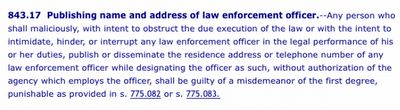
A federal judge has struck down a Florida law prohibiting the publication of a police officer’s name, phone number or address, calling the statute an unconstitutional restraint on speech. The decision leaves Arizona, Colorado and Washington state with similar laws on the books. Florida authorities said Wednesday they were mulling whether to appeal. Robert Brayshaw, a 35-year-old apartment manager, brought the challenge to Florida’s law after he was briefly jail in 2008 for posting personally identifying information of a Tallahassee police officer on RateMyCop.com — a 2-year-old website that lets users rate and comment on the uniformed police officers in their community. RateMyCop uses public records requests to gather the names and, in some cases, badge numbers of thousands of uniformed cops at police departments around the country, and allows users to post comments about police they’ve interacted with. The site’s launch in 2008 drew cries of outrage from police, who complained that they’d be put at risk if their names were on the internet.
school secretly snapped 1000s of students at homefrom threat level:
A webcam spying scandal at a suburban Philadelphia school district is broadening, with lawyers claiming the district secretly snapped thousands of webcam images of students using school-issued laptops without the pupils’ knowledge or consent.
Some of the images included pictures of youths at home, in bed or even “partially dressed,” according to a Thursday filing in the case. Pupils’ online chats were also captured, as well as a record of the websites they visited.
When the story first broke in February, the district said the cameras were activated only handful of times when a laptop was reported stolen or missing — an assertion lawyers suing the district say is false.
“Discovery to date has now revealed that thousands of webcam pictures and screen shots (.pdf) have been taken from numerous other students in their homes, many of which never reported their laptops lost or missing,” attorney Mark Haltzman wrote in a Thursday federal court filing.
In February, the Lower Merion School District deactivated the webcam-tracking program secretly lodged on 2,300 student laptops...
Thursday’s filing, which claims 400 images of Robbins were taken during a two-week period last fall, also says that an IT administrator at the district “may be a voyeur.” Lawyers suing the district are urging a federal judge presiding over the case to grant a forensic examination of administrator’s personal computer.
The lawsuit said the administrator, who has been placed on paid leave, “invokes the Fifth Amendment to every question asked of her, including a question asked as to whether she had ever downloading (sic) pictures to her own computer, including pictures of students who were naked while in their home.”
The lawsuit seeks class-action status to represent all the district’s 2,300 high school students.
Proposed legislation announced late Thursday by Sen. Arlen Specter (D-Pennsylvania) would make it a federal felony to remotely spy on private residences and hotel rooms with video cameras.
 from threat level
:
Yahoo prevailed Friday over Colorado federal prosecutors in a legal battle testing whether the Constitution’s warrant requirements apply to Americans’ e-mail.
Saying the contested e-mail “would not be helpful to the government’s investigation,” (.pdf) the authorities withdrew demands for e-mail in a pending and sealed criminal case. For the moment, the move ends litigation over the hotly contested issue of when a warrant under the Fourth Amendment is required for Yahoo and other e-mail providers to release consumer communications to the authorities.
The brouhaha concerned a 1986 law that already allows the government to obtain a suspect’s e-mail from an internet service provider or webmail provider without a probable-cause warrant, once it’s been stored for 180 days or more. The government contended, and then backed off Friday, that it could get e-mail less than 180-days old if that e-mail has been read by the owner, and that the Constitution’s Fourth Amendment protections don’t apply.
Yahoo was backed (.pdf) by the Electronic Frontier Foundation, Google and the Center for Democracy & Technology in challenging the government’s position. It defied a court order to turn over those e-mails to the feds in a Colorado criminal probe that is under seal. Litigation over the topic ensued, and the government blinked in a legal standoff highlighting antiquated privacy laws.
Had the courts adopted the government’s position, (.pdf) the vast majority of Americans’ e-mail would be accessible to the government without probable cause, whenever law enforcement believes the messages would be relevant to a criminal investigation, even if the e-mail’s owner was not suspected of wrongdoing.
Still, the government’s move does not resolve the privacy issue, but merely instead delays it for a later day.flashback: fcc loses net neutrality battle against comcast
court: fcc had no right to sanction comcast for p2p blocking  from washington post
:
Comcast on Tuesday won its federal lawsuit against the Federal Communications Commission in a ruling that undermines the agency's ability to regulate Internet service providers just as it unrolls a sweeping broadband agenda.
The decision also sparks pressing questions on how the agency will respond, with public interest groups advocating that the FCC attempt to move those services into a regulatory regime clearly under the agency's control.
The U.S. Court of Appeals for the District of Columbia, in a 3-0 decision, ruled that the FCC lacked the authority to require Comcast, the nation's biggest broadband services provider, to treat all Internet traffic equally on its network.
That decision -- based on a 2008 ruling under former FCC chairman Kevin Martin -- addresses Comcast's argument that the agency "failed to justify exercising jurisdiction" when it ruled Comcast violated broadband principles by blocking or slowing a peer-sharing Web site, Bit Torrent.
But it also unleashed a broader debate over the agency's ability to regulate broadband service providers such as AT&T, Comcast and Verizon Communications.
The judges focused on whether the FCC has legal authority over broadband services, which are categorized separately from phone, cable television and wireless services. The agency currently has only "ancillary authority" over broadband services, a decision made by past agency leaders in an attempt to keep the fast-moving Internet services market at an arm's distance from the agency.update: undaunted by comcast court victory,
fcc moves ahead with broadband plans


 new yorker mag sheds new light on nsa's warrantless wiretapping & data mining*