


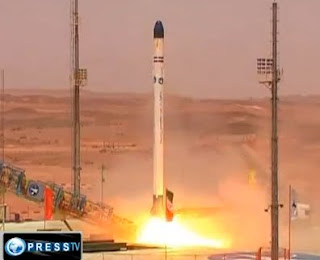
 Iran launched Rasad-1 (Observation-1) into orbit, Wednesday. You have to like the humor in a Satnews Daily article, where subheading reads, "Iran... Why, Of Course This Is A Satellite Tasked With Peaceful Intentions (Launch)." Rasad-1 follows launch of Omid (Hope) in 2009. Iran's observation satellite weighs 34 pounds, will orbit every 90 minutes 162 miles up at an inclination of 55.7 degrees. Where's the right wing fear mongers to recite party line: rocket tech used in launch can also launch missiles? The present writer felt a deja vu to a more innocent time when space exploration meant new frontiers with wide horizons other than militarization and weaponization! The launch looked rudimentary if well-done with a resemblance to the fifties and sixties. "Seh do yek"...how do you say lift off in Farsi and may get more familiar with their countdown in time?
|
|---|
Showing posts with label satellite. Show all posts
Showing posts with label satellite. Show all posts
Thursday, June 16, 2011
iran launches second satellite
Iran launched Rasad-1 (Observation-1) into orbit, Wednesday. You have to like the humor in a Satnews Daily article, where subheading reads, "Iran... Why, Of Course This Is A Satellite Tasked With Peaceful Intentions (Launch)." Rasad-1 follows launch of Omid (Hope) in 2009. Iran's observation satellite weighs 34 pounds, will orbit every 90 minutes 162 miles up at an inclination of 55.7 degrees. Where's the right wing fear mongers to recite party line: rocket tech used in launch can also launch missiles? The present writer felt a deja vu to a more innocent time when space exploration meant new frontiers with wide horizons other than militarization and weaponization! The launch looked rudimentary if well-done with a resemblance to the fifties and sixties. "Seh do yek"...how do you say lift off in Farsi and may get more familiar with their countdown in time?

Tuesday, April 12, 2011
50th anniversary: first man in space
50th anniversary of first manned space flight
 Russian cosmonaut Yuri Gagarin blasted off aboard Vostok 1, on April 12, 1961, to become first man in space. The event proved a second political coup for the Soviet Union. The Communists had put Sputnik the first satellite in orbit. You can view a condensed version of Gagarin's story in just 39 seconds on YouTube.
related: vladimir ilyushin - the real first man in space?
Russian cosmonaut Yuri Gagarin blasted off aboard Vostok 1, on April 12, 1961, to become first man in space. The event proved a second political coup for the Soviet Union. The Communists had put Sputnik the first satellite in orbit. You can view a condensed version of Gagarin's story in just 39 seconds on YouTube.related: vladimir ilyushin - the real first man in space?
Wednesday, December 29, 2010
zombiesat is alive!
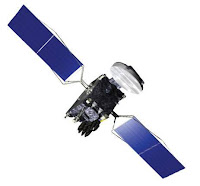 Intelsat's Galaxy 15 communications satellite, after drifting in orbit since last April, has been revived! The zombiesat gained notoriety for its intrusions on neighbors, after its electronic brains were supposedly fried by a solar flare, which caused several crises and interference avoidance maneuvers. The solution was to drain power from the comsat and induce a system reboot, which occurred on Dec. 23, 2010. The satellite is currently in safe mode and no longer poses a threat to the neighborhood. Intelsat has a FAQ section, which includes information on an in-orbit protection plan! Intelsat remains hopeful software can be reloaded from the ground and the satellite's functions fully restored! Or, will the zombiesat need to eat other satellite brains in order to survive?
Tuesday, December 14, 2010
voyager 1 nears interstellar space
 Universe Today reports Voyager 1, launched on Sept. 5 1977, has reached a point in outer space where there is no solar wind. The solar wind has measured zero since June, when Voyager was 10.6 billion miles from the Sun. “The solar wind has turned the corner,” said Ed Stone, Voyager project scientist based at the California Institute of Technology in Pasadena, Calif. “Voyager 1 is getting close to interstellar space.” Voyager 1 has reached the boundary of the solar system, scientists believe the satellite will cross from the heliosphere and enter interstellar space in about 4 years.
Thursday, November 25, 2010
11/25 defcon: sick, switch, risks
US launches giant eavesdropping satellite*
govt focusing on cyber warfare, armed forces chief reveals*
study says wifi makes trees sick*
3rd eye: nyu artist gets camera implanted in head*
should obama's 'internet kill switch' power be curbed?*
cyber shopping poses fraud risks*
wikileaks diplomatic cable dump reportedly imminent*
govt focusing on cyber warfare, armed forces chief reveals*
study says wifi makes trees sick*
3rd eye: nyu artist gets camera implanted in head*
should obama's 'internet kill switch' power be curbed?*
cyber shopping poses fraud risks*
wikileaks diplomatic cable dump reportedly imminent*
Wednesday, November 24, 2010
x-37b initial mission near end?
 The Air Force's X-37B space plane may be near end of initial mission, reports CS Monitor article. The spacecraft, also known as Orbital Test Vehicle 1, launched April 22nd and built for 270 day flights, suggests it may be on homestretch. The mission of the secretive X-37B is still a subject of much speculation. Ted Molczan, a veteran skywatcher, observes "ground tracks that nearly repeat after two, three or four days have long been a feature of U.S. imaging reconnaissance satellites, which leads me to suspect that X-37B is carrying experimental sensors for that purpose". The spacecraft may be testing experimental sensors before they are placed on expensive satellites? X-37B will land at Vandenberg AFB if the mission is completed as planned.
Thursday, October 7, 2010
10/7 defcon: spooks, satnav & sightings
pentagon says 'the global cyberwar is just beginning'*
 military spooks step up war on leakers*
obama pressures isp's to censor websites*
microsoft wants govt licensing net access*
aol says infowars 'whipping the internet into a frenzy of anxiety'*
iran say it has captured 'western spies' involved in nuclear cyberattack*
researchers using rat-robot hybrid to design better brain machine interfaces*
uk man dies after satnav sends him into a reservoir*
ufo forces airport closure in china*
best image yet of comet closing in on earth*
military spooks step up war on leakers* obama pressures isp's to censor websites*
microsoft wants govt licensing net access*
aol says infowars 'whipping the internet into a frenzy of anxiety'*
iran say it has captured 'western spies' involved in nuclear cyberattack*
researchers using rat-robot hybrid to design better brain machine interfaces*
uk man dies after satnav sends him into a reservoir*
ufo forces airport closure in china*
best image yet of comet closing in on earth*
Thursday, August 26, 2010
defcon 8/26: dirty tricks & moon rocks
realtime track of x-37b: US military’s top secret x-37b shuttle 'disappeared' for 2wks, changed orbit*
 flashback: military launches x-37b*
secretive mini-shuttles, dirty tricks spy sats & more*
sweden pulls wikileaks warrant*
video: scientists hack into cars' computers & control brakes, engine*
flashback: austin hacker disables more than 100 cars remotely*
missing moon rock unveiled in colorado*
video: physicist kaku talks aliens on msnbc*
 flashback: military launches x-37b*
 secretive mini-shuttles, dirty tricks spy sats & more*
sweden pulls wikileaks warrant*
video: scientists hack into cars' computers & control brakes, engine*
flashback: austin hacker disables more than 100 cars remotely*
missing moon rock unveiled in colorado*
video: physicist kaku talks aliens on msnbc*
Thursday, August 12, 2010
defcon 8/12: cyber lies & gag orders
cyber lie exposed: power plants not connected to internet*
 dhs needs to take threat of emp attack seriously, physicist warns*
google ceo: no anonymity is the future of web*
google raided by s. korea police street view probe*
appeals court rules against secret police gps tracking*
cars hacked through wireless tire sensors*
geoeye & digitalglobe get $7b from intel agency to implement next-gen sat imaging*
'john doe' who fought fbi spying freed from gag order after 6yrs*
dhs needs to take threat of emp attack seriously, physicist warns* google ceo: no anonymity is the future of web*
google raided by s. korea police street view probe*
appeals court rules against secret police gps tracking*
cars hacked through wireless tire sensors*
geoeye & digitalglobe get $7b from intel agency to implement next-gen sat imaging*
'john doe' who fought fbi spying freed from gag order after 6yrs*
Thursday, May 27, 2010
defcon 5/27: hacking cough, fever & runny nodes
man infects himself with computer virus*
 video: cyberwar could cripple the nation*
clarke: next terrorist threat will be from those resisting technology*
india sees cyber warfare as new-gen security threat*
second man jailed over scientology ddos attacks*
space so full of junk that a satellite collision could destroy communications on earth*
shuttle atlantis completes 32nd & final flight*
video: cyberwar could cripple the nation* clarke: next terrorist threat will be from those resisting technology*
india sees cyber warfare as new-gen security threat*
second man jailed over scientology ddos attacks*
space so full of junk that a satellite collision could destroy communications on earth*
shuttle atlantis completes 32nd & final flight*
Thursday, May 13, 2010
defcon 5/13: web tax, hacks & output jacks
fcc lets hollywood turn off your output jacks*
 fcc sets plan for limited broadband control*
big brother is watching in high definition*
video: are spies controlling your pc's web cam?*
rogue satellite may impact cable tv in US*
world health org moving ahead on billions in internet & other taxes*
richard clarke says cyber attack will wreck US in 15min*
why former anti-terrorism czar believes a cyber attack could bring US collapse*
white house adviser says no evidence of cyber attack in wall street plunge*
pentagon turns to brain implants to repair damaged minds*
russian generals want their space weapons, too*
the militarization of outer space: the pentagon 'space warriors'*
the ever-growing problem of space junk*
jupiter loses a stripe*
prosecutors cite confidential informant in iphone probe*
nintendo ceo: apple is the 'enemy of the future'*
fcc sets plan for limited broadband control* big brother is watching in high definition*
video: are spies controlling your pc's web cam?*
rogue satellite may impact cable tv in US*
world health org moving ahead on billions in internet & other taxes*
richard clarke says cyber attack will wreck US in 15min*
why former anti-terrorism czar believes a cyber attack could bring US collapse*
white house adviser says no evidence of cyber attack in wall street plunge*
pentagon turns to brain implants to repair damaged minds*
russian generals want their space weapons, too*
the militarization of outer space: the pentagon 'space warriors'*
the ever-growing problem of space junk*
jupiter loses a stripe*
prosecutors cite confidential informant in iphone probe*
nintendo ceo: apple is the 'enemy of the future'*
Sunday, March 7, 2010
dark, dangerous asteroids found lurking near earth
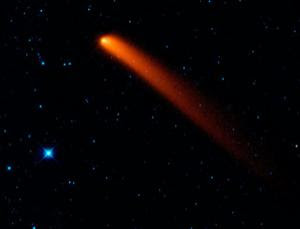 from new scientist: An infrared space telescope has spotted several very dark asteroids that have been lurking unseen near Earth's orbit. Their obscurity and tilted orbits have kept them hidden from surveys designed to detect things that might hit our planet.
Called the Wide-Field Infrared Survey Explorer (WISE), the new NASA telescope launched on 14 December on a mission to map the entire sky at infrared wavelengths. It began its survey in mid-January.
In its first six weeks of observations, it has discovered 16 previously unknown asteroids with orbits close to Earth's. Of these, 55% reflect less than one-tenth of the sunlight that falls on them, which makes them difficult to spot with visible-light telescopes. One of these objects is as dark as fresh asphalt, reflecting less than 5% of the light it receives.
Many of these dark asteroids have orbits that are steeply tilted relative to the plane in which all the planets and most asteroids orbit. This means telescopes surveying for asteroids may be missing many other objects with tilted orbits, because they spend most of their time looking in this plane.
Fortunately, the new objects are bright in infrared radiation, because they absorb a lot of sunlight and heat up. This makes them relatively easy for WISE to spot.
Subscribe to:
Posts (Atom)


