related updates: former cia head keith alexander says we should 'build a new internet to improve cybersecurity'*
pentagon perception manager knows how to manipulate search engine algorithm*
|
|---|
 from kurt nimmo: Obama has proposed legislation that will give the Department of Homeland Security more “autonomy” in its effort to protect civilian computer networks from ostensible cyber attack, according to Information Week. White House officials testified Monday before the Senate Committee on Homeland Security and Governmental Affairs about the comprehensive plan presented by the administration two weeks ago to create legislation to protect critical infrastructure and networks. It will merge operations with the Pentagon.
 Zeus attack kits are filling a niche in best spirit of capitalism and with as much moral perspective! Attack or exploit kits, as they are known in the industry, are growing more prevalent. You can become a cybercriminal without technical expertise or time dedicated to build your own exploit! Symantec, internet security firm and maker of Norton Anti-Virus, issued a recent threat report on proliferation of this cybercrime. Symantec TV also provides eye-opening video: Attack Toolkits in 90 seconds. A News.com.au article surveys threat posed by attack kits. Zeus sells for $700. "Other known crimeware tools include the Fragus Exploit Kit and the Spyeye." An M86 Security Lab Report supplies a nice history and growth of this cyber-threat! A must read for anyone interested in offensive computing!
 Cyber security expert Ralph Langner reports his research into Stuxnet in a must see video from a recent Ted Talk. While an article by Washington's Blog, "Could a Rogue Computer Virus be Used to Shut Down Nuclear Plants Worldwide?", has gone viral; the real news is Langner's revelation that "Stuxnet is generic", which implies its flexible code can easily attack other industrial sites not just nuclear plants. The Ugly Truth quotes Langner's pointed comment, “you fail to understand that the hacker underground has been studying control systems for years without any success. You fail to understand that this community will eagerly dismantle Stuxnet as a blueprint for how to cyber-attack installations from the cookie plant next door to power plants.” Virus protection will be at a premium for commercial applications!
 Cybersecurity firm Ahnlab, in a guardian.co.uk article, reported a denial of service attack (DoS) that targeted "... websites belonging to South Korea's presidential office, the foreign ministry, the national intelligence service, US Forces Korea and major financial institutions." Park Kun-woo, Ahnlab spokesman, advised attacks were similar to past ones - a DoS type of attack, and largely, same websites involved. Ahnlab reported a computer user found a bug, and after analysis, discovered malware designed to attack websites. The targets were warned in advance, as a result, experienced only brief slow downs. South Korean officials, in the past, have traced cyberattacks back to China. The current article is only reporting, "it was not immediately clear from where Friday's attack originated." Does this represent new posturing - a reversal - in messages sent in a spirit of keeping peace?
 Cybersecurity expert Peter Sommer of the London School of Economics warns nations against following Pentagon's lead of developing a military division to defend against cyber threats in recent article at NewScientist website. "The military can only defend its own networks not the private-sector critical networks we all depend on for gas, water, electricity and banking, making such military efforts a waste of taxpayers' money." Sommer, co-author of a very readable new report, "Reducing Systemic Cybersecurity Risk", advises governments should quit panicking and take a disciplined approach. It's, possibly, time to sit up and take notice when advice is coming from the author of "The Hacker's Handbook," first published in 1985.
 Cybersecurity experts in the United States report an increase in internet traffic to their websites from Iran. The experts add there appears to be, also, strenuous efforts to hide the traffic's origin. A Fox News article, "Stuxnet Worm Still Out of Control at Iran's Nuclear Sites, Experts Say", infers from the internet traffic there are still problems. The article describes the Stuxnet worm as "...equipped with a warhead that targeted and took over the controls of the centrifuge systems at Iran’s uranium processing center in Natanz, and it had a second warhead that targeted the massive turbine at the nuclear reactor in Bashehr". Ralph Langner, a German expert, believes Iranians need to throw out their computers but adds they can't, "they will just continually reinfect themselves".
 from washington post: Now it is official: The most significant breach of U.S. military computers was caused by a flash drive inserted into a U.S. military laptop on a post in the Middle East in 2008. In an article to be published Wednesday discussing the Pentagon's cyberstrategy, Deputy Defense Secretary William J. Lynn III says malicious code placed on the drive by a foreign intelligence agency uploaded itself onto a network run by the U.S. military's Central Command. "That code spread undetected on both classified and unclassified systems, establishing what amounted to a digital beachhead, from which data could be transferred to servers under foreign control," he says in the Foreign Affairs article.
 consumer group sniffs congresswoman's open wi-fi*
  report: US building system to detect cyber-attacks*
  comprehensive cyber legislation approved*
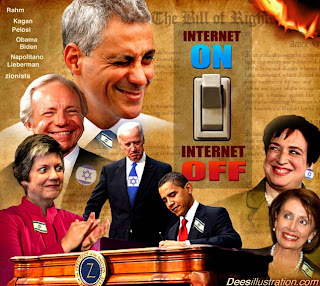
  from paul joseph watson & alex jones: The move to shut down and regulate the Internet under a new government-controlled system has accelerated into high gear with the announcement that the government’s cybersecurity strategy revolves around issuing Internet users with ID “tokens” without which they will not be able to visit websites, the latest salvo against web freedom which, in combination with Senator Joe Lieberman’s ‘kill switch’ bill, will serve to eviscerate the free Internet as we know it.
 from techworld: A US Senate committee has approved a wide-ranging cybersecurity bill that some critics have suggested would give the US president the authority to shut down parts of the Internet during a cyberattack.
 from defence talk: The Pentagon would consider a military response in the case of a cyber attack against the United States, a US defense official said on Wednesday. Asked about the possibility of using military force after a cyber assault, James Miller, undersecretary of defense for policy, said: "Yes, we need to think about the potential for responses that are not limited to the cyber domain."
 summit in dallas targets cybercrime - sponsored by goldman sachs & microsoft, etc*
  from fcw: Cyberattacks aren’t confined by governmental or national boundaries, and neither should cybersecurity programs, Sen. Jay Rockefeller (D-W. Va.), said recently in calling on government and industry to work together to meet the rapidly rising tide of attacks on U.S. information systems.
 from sacramento press: Central Intelligence Agency director Leon Panetta told 300 Sacramento Metro Chamber Cap-to-Cap delegates that the next “Pearl Harbor” is likely to be an attack on the United States’ power, financial, military and other Internet systems.
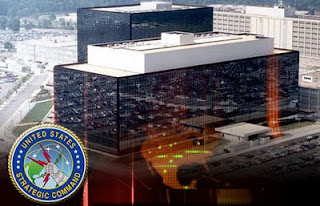 from antifascist calling: When U.S. Secretary of Defense Robert M. Gates launched Cyber Command (CYBERCOM) last June, the memorandum authorizing its stand-up specified it as a new "subordinate unified command" under U.S. Strategic Command (STRATCOM), one that "must be capable of synchronizing warfighting effects across the global security environment as well as providing support to civil authorities and international partners."